Broadband Protocols
Point to Point Protocol (PPP)
Point to Point Protocol (PPP) for broadband communications is a set of instructions used to transmit data between two directly connected devices.
- Point to Point Protocol (PPP) is a byte-oriented protocol broadly used for high-traffic data transmissions.
- PPP functions at the data link layer, which transmits data between two devices on the same network.
- PPP is designed to link devices, so the endpoints do not need to be the same vendor to work.
Configuring PPP
When configuring PPP for the devices on your network, you have the following options:
-
Multilink connection provides a method for spreading traffic across multiple distinct PPP connections.
-
Compression increases throughput by reducing the amount of data in the frame.
-
Authentication occurs when connected devices exchange authentication messages using one of two methods:
-
Password Authentication Protocol (PAP) is a password authentication option that is hard to obtain plaintext from if passwords are compromised.
-
Challenge Handshake Authentication Protocol (CHAP) is a three-way handshake authentication that periodically confirms the identity of the clients.
-
-
Error detection includes Frame Check Sequence (FCS) and looped link detection.
-
Frame Check Sequence (FCS) is a number included in the frame calculated over the Address, Control, Protocol, Information, and Padding fields used to determine if there has been data loss during transmission.
-
Looped link detection in PPP detects looped links using magic numbers. A magic number is generated randomly at each end of the connection, so when a looped message is received, the device checks the magic number against its own. If the line is looped, the number will match the sender’s magic number, and the frame is discarded.
-
Sub-protocols for PPP
In addition, two sub-protocols for PPP occur on the network layer when the network decides what physical path the information will take. These protocols use the configuration options you set for the endpoints.
-
Network Control Protocol (NCP) will be used to negotiate optional configuration parameters and facilities for the network layer. There is an NCP for each higher layer protocol used by the PPP.
-
Link Control Protocol (LCP) initiates and terminates connections automatically for hosts. It automatically configures the interfaces at each end like magic numbers and selecting for optional authentication.
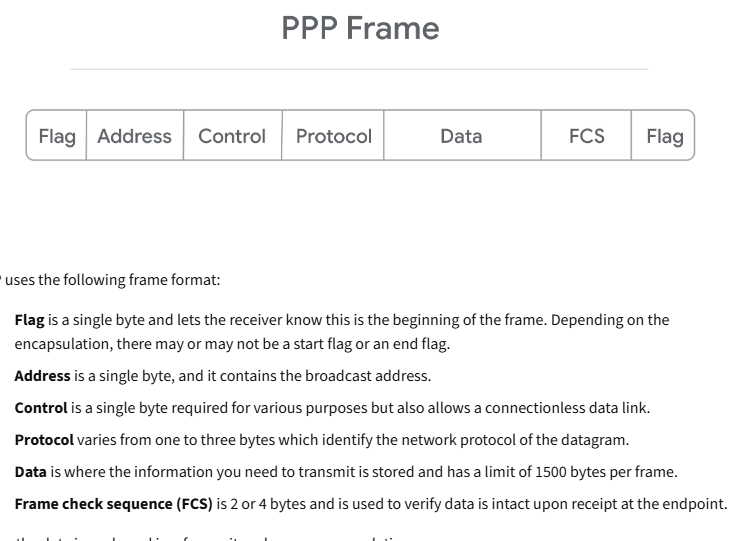
Encapsulation is the process by which each layer takes data from the previous layer and adds headers and trailers for the next layer to interpret.
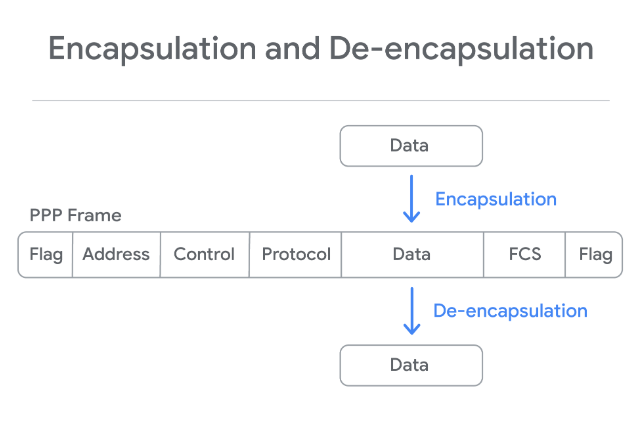
These frames are sent to the other endpoint where the process is reversed, which is called De-encapsulation.
PPP can get expensive and hard to manage due to all the direct cables and links required. In this case, you may want to switch to a multi-access Ethernet solution. Point to Point Protocol over Ethernet is a protocol made to bridge the gap between directly connected endpoints and other devices.
Point to Point Protocol over Ethernet (PPPoE)
Point to Point protocol over Ethernet (PPPoE) is a way of encapsulating PPP frames inside an ethernet frame.
- PPPoE is a solution for tunneling packets over the DSL connection service provider’s IP network and from there to the rest of the Internet.
- Like PPP, PPPoE provides authentication, encryption, and compression, though it primarily uses Password Authentication Protocol (PAP) for authentication.
PPPoE is an encapsulation of PPP inside an ethernet frame. PPPoE retains the same architecture, configuration options, and frame data as PPP but with one extra layer of ethernet encapsulation.